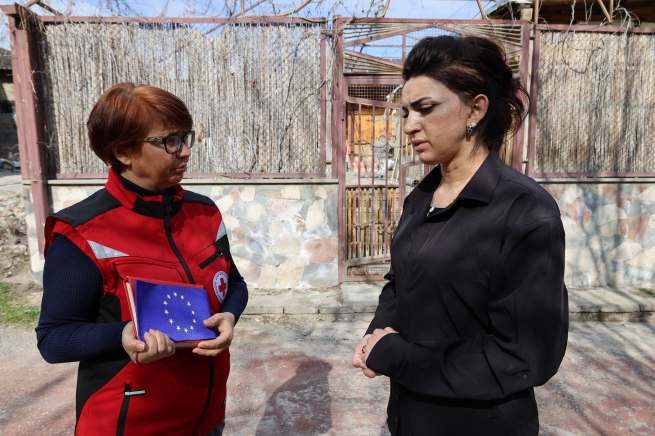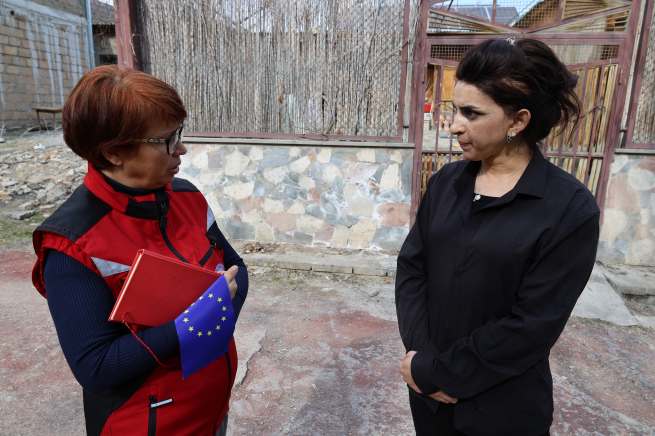







Anush’s life changed dramatically in September 2023, when the escalation of the conflict in Nagorno-Karabakh forced her and her four sons, aged 18, 16, 8, and 6, to flee their home in Stepanakert. Alongside other displaced families, they travelled to Armenia in the back of a truck, leaving behind their home and much of their belongings while facing deep uncertainty about the future.
After arriving in Armenia, the family began adjusting to a new environment while coping with the emotional and practical challenges of displacement. Pre-existing family tensions intensified under the pressure of their new circumstances. Her husband’s alcohol dependency, which worsened during this period of stress and uncertainty, created an unstable environment within the household and increasingly affected the well-being of the children, placing the family at risk of breakdown.
Coordinated support for protection and well-being
Following a comprehensive needs assessment, an individual case management plan was developed to ensure an integrated and structured response.
Thannks to the RENEW project funded by the European Union, Anush began receiving regular Mental Health and Psychosocial Support (MHPSS) sessions with an Armenian Red Cross Society’s (ARCS) psychologist. These sessions provided a safe and confidential space where she could process trauma related to displacement, strengthen coping mechanisms, and gradually regain confidence in managing her situation.
As the sessions progressed, Anush felt increasingly empowered to make decisions aimed at protecting her children and restoring stability within the family. With improved emotional resilience and professional guidance, she decided to separate in order to safeguard her children’s well-being.
At the same time, the case manager facilitated referrals to legal services within the project framework. A project-supported lawyer provided legal counseling and initiated the necessary procedures, while continuous follow-up ensured that Anush received guidance throughout the process.
Protecting children and rebuilding daily life
Today, Anush lives independently with her four sons in a safer and more stable environment in Metsamor.
The two older boys are enrolled in a local college, taking steps toward building their professional future. One of them is also receiving individual MHPSS support to address emotional and adjustment challenges linked to displacement and family changes.
The two younger children attend the project’s “Smiley Club,” where they participate in structured educational, social, and recreational activities designed to promote resilience, healthy development, and social integration.
During the family’s most vulnerable period, humanitarian assistance provided essential support. The family received essential food and clothing support from the Armenian Red Cross Society, helping to reduce immediate financial pressure and ensure dignified living conditions while longer-term solutions were being established.
A path toward recovery
Although the family continues to face economic and social challenges through sustained psychosocial support, legal guidance, humanitarian aid, and structured case management, a pathway toward stability was created.
Today, Anush speaks about the future with cautious optimism. She hopes that once her older sons graduate, they will be able to find employment and contribute to the family’s stability and independence.
Her story illustrates how integrated social work, combining protection, MHPSS, legal assistance, child-focused programming, and basic needs support can transform a situation of acute vulnerability into one of stability and hope.
The RENEW project, implemented with the support of European Union Humanitarian Aid, aims to improve the living conditions and psychosocial well-being of 16,020 women, men, girls, and boys displaced by the Nagorno-Karabakh conflict, which escalated in 2023 and led to a massive influx of over 100,000 individuals seeking refuge in Armenia. Implemented in the regions of Ararat, Armavir, and Kotayk, the project focuses on supporting displaced persons in rebuilding their lives and fostering stability and resilience within their new communities.